Guide
Second VA Loan: Keep Your Home, Buy Another, and Know Your Entitlement
Short answer
Yes, you can have two VA loans at the same time. If you keep your current VA-financed home, the next purchase uses your remaining entitlement: 25 percent of the county loan limit minus what the open loan still uses. In most U.S. counties, including Shasta County, the 2026 limit is $832,750, so that starts at $208,187.50. Multiply what is left by four to see the price you can buy with no down payment. The new home has to be your primary residence, and you have to qualify for both payments.
Published by Chris Lamm, NMLS 209221Published Sources checked
Can you have two VA loans at the same time?
Yes. The VA home loan is not a one-time benefit, and there is no lifetime cap on how many times you use it. What limits a second VA loan is entitlement, the amount VA guarantees to your lender. If your first VA loan is still open, part of your entitlement is tied up in it. Whatever is left can go toward the next home. To see your own numbers, jump to the calculator.
Three things have to line up. You need enough remaining entitlement, or a down payment to cover the gap. The new home has to be the home you live in, because VA loans are for your own occupancy. And you have to qualify for both mortgage payments, unless the old home's rent can be counted under the lender's rules.
Reasons for keeping the first home can include a move for work or orders, a growing family that needs more room, or wanting to hold the first house as a long-term rental instead of selling it.
How VA entitlement works, in plain numbers
VA guarantees part of each loan so the lender can lend with no down payment. Basic entitlement is $36,000 and covers loans of $144,000 or less. For anything larger, bonus entitlement (also called second-tier) brings the guaranty to 25 percent of the loan. That 25 percent is the number to remember.
If you have full entitlement, meaning you have never used it or it has been restored, there is no VA loan limit. Since January 1, 2020, the limit on how much you can borrow with no down payment comes from what you qualify for and what the lender will do, not from a county cap.
If you have partial entitlement, because a VA loan is still open, the county one-unit conforming limit comes back into the math. Your remaining entitlement is 25 percent of that limit minus the entitlement your open loan still uses. Lenders generally want your entitlement plus any down payment to cover 25 percent of the price or value, whichever is less.
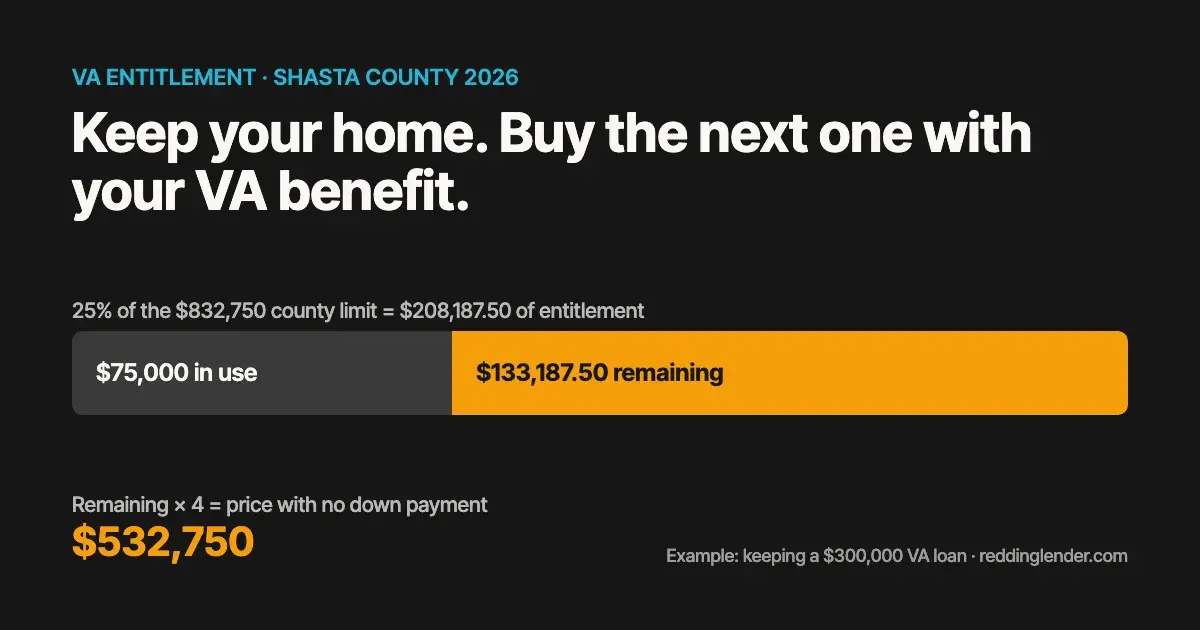
Example: keeping a $300,000 VA loan and buying again in Shasta County
1. Your entitlement bucket: 25% of the county limit
25% × $832,750 (Shasta County, 2026) = $208,187.50
In use $75,000Left $133,187.50This example assumes the COE shows $75,000 charged on the $300,000 loan. Use your COE's actual amount.
2. What the leftover buys with no down payment
$133,187.50 × 4 = $532,750
3. Buying above that price
At $600,000, lenders look for 25% coverage: $150,000. Entitlement covers $133,187.50, so the down payment is about $16,812.50 (2.8% of the price), not 20%.
The county math for 2026
VA uses the FHFA one-unit conforming limit for the county where the new home is. For 2026 that limit is $832,750 in all but 160 of the country's 3,235 counties, including Shasta County. Higher-cost counties go up to $1,249,125 in most of the country, with higher limits in parts of Hawaii. Twenty-five percent of $832,750 is $208,187.50. Subtract the entitlement your current loan uses, which for a loan over $144,000 is 25 percent of its original amount, and you have your remaining entitlement. Multiply by four to find the price you can reach with no down payment.
Above that price, the down payment depends on the purchase price and the entitlement you have left. Lenders generally look for enough cash to bring entitlement plus down payment to 25 percent of the price, so it can be well under 20 percent or, at much higher prices, more. The table and the calculator below walk through it for any county. Your Certificate of Eligibility shows the exact entitlement charged, so we always confirm the real number before you write an offer.
Second VA loan examples, 2026 (Shasta County unless noted)
| Situation | Remaining entitlement | No-down-payment price | Down payment at the example price |
|---|---|---|---|
| Full entitlement (never used, or restored) | Full | No VA limit; you qualify on income and credit | $0 at any price you qualify for |
| Keeping a $300,000 VA loan (charged $75,000) | $133,187.50 | $532,750 | $16,812.50 at $600,000 (2.8%) |
| Keeping a $450,000 VA loan (charged $112,500) | $95,687.50 | $382,750 | $29,312.50 at $500,000 (5.9%) |
| San Diego County ($1,104,000 limit), keeping a $300,000 VA loan | $201,000 | $804,000 | $24,000 at $900,000 (2.7%) |
| Los Angeles County ($1,249,125 limit), keeping a $300,000 VA loan | $237,281.25 | $949,125 | $12,718.75 at $1,000,000 (1.3%) |
Second VA loan calculator
Enter the VA loan you are keeping and the price of the next home, then pick the state and county. It starts on Shasta County and covers every U.S. county's 2026 limit.
For loans over $144,000 we estimate 25% of the original amount. Your Certificate of Eligibility shows the exact figure.
For a new loan of $144,000 or less, ask your lender to calculate available basic entitlement.
If it is below what the loan needs, the calculator uses the required amount.
2026 one-unit limit used: $832,750. Most U.S. counties, including Shasta, are at $832,750; only higher-cost counties are listed by name.
Remaining entitlement times four. Above this price, lenders generally look for a down payment that brings entitlement plus cash to 25 percent of the price.
An estimate from published VA rules and FHFA limits. Income, credit, the appraisal and the lender's own guidelines decide the actual loan. Closing costs are separate.
Rates and terms subject to change without notice. Not a commitment to lend. Not available in all states. This is not tax, legal, or financial advice. Consult a qualified professional for your specific situation.
Private lender. Not affiliated with or endorsed by the U.S. Department of Veterans Affairs or any government agency.
Optional. Send this scenario to the team for review.
Keep the house as a rental, or sell it?
This is the decision most veterans are really weighing, and the math is only part of it. Keeping the home builds a second asset and preserves the existing loan's rate and terms. Selling and paying off the VA loan lets you request restoration of your entitlement and frees the equity. The table below lays the options side by side, and a few questions settle most of it.
One option for a move-up buyer who qualifies for both payments: close on the new home with zero down so the move is not hostage to the sale, then put the sale proceeds toward the new loan as a large principal payment. A principal payment does not lower your scheduled monthly payment on its own; the payment stays the same and the loan pays off sooner, unless your servicer agrees to recast the loan. It is often the smoothest, least stressful way to make the move, and we will tell you up front where the numbers might not work.
- Can you carry both payments? Lenders count the old home's rent only with the documentation their rules require, so plan on qualifying with some or all of both payments.
- Is the rent worth the landlord work and the repairs on an older home? Include property-management costs when comparing rent with expenses.
- If you sell, have you owned and lived in the home at least two of the last five years? The IRS lets you exclude up to $250,000 of gain on a main home, or $500,000 for a married couple filing jointly, which matters when you compare keeping against selling. Ask your tax adviser how it applies to you.
- How much does the second purchase need? Sufficient remaining entitlement may eliminate the down payment. Closing costs still apply, and any funding fee depends on your exemption and down payment.
Keep, sell, pay off or assume: how each choice affects a second VA loan
| Choice | Entitlement for the next home | What to weigh |
|---|---|---|
| Keep the first home and its VA loan | Remaining entitlement only (25% of the county limit minus what is charged) | Both payments, rental documentation, possible down payment above the zero-down price |
| Sell and pay off the VA loan | Full entitlement after you request restoration | Sale timing, capital gains exclusion, moving twice if the closings do not line up |
| Pay off the loan and keep the home | Full entitlement through the one-time restoration | Cash or refinance needed to pay it off; one-time use only |
| Another eligible veteran assumes the loan | Full entitlement if they substitute theirs | Finding a qualified veteran buyer; VA Forms 26-1880 and 26-8106 |
Can you use a VA loan for a second home or rental?
Not for a vacation home or a pure investment property. VA loans require that the home be for your own occupancy. What does work is buying a new primary residence and keeping the old one. Confirm rental conversion and how rental income will be treated with your lender and your servicer.
Other routes we use for veterans who want more than one property:
- Buy a two- to four-unit property with your VA benefit and live in one unit.
- Ask about a conventional second-home loan for a cabin or lake place you will use yourself.
- For a rental, ask whether a DSCR investor loan fits the property and your circumstances.
- Keep your entitlement free for your next primary home and finance investments with our investor lending options.
Getting your entitlement back
Entitlement is restored in three ways. If you sell the home and the VA loan is paid off, you can have it restored. If you pay the loan off and keep the home, VA allows a one-time restoration. And if another eligible veteran assumes your loan and substitutes their entitlement, yours comes back.
You request restoration through your lender or with VA Form 26-1880, and a substitution also needs VA Form 26-8106 from the veteran assuming the loan. If VA ever paid a claim on a prior loan, that has to be repaid before entitlement is restored. Your Certificate of Eligibility shows what is still charged.
The funding fee on a second VA loan
The funding fee is higher after first use when you put less than 5 percent down: 3.3 percent instead of 2.15 percent. With 5 percent or more down, it is the same either way. Veterans who receive VA compensation for a service-connected disability are exempt, and the exemption applies to a second VA loan the same as the first.
California veterans: the disabled veterans' property tax exemption
California adds a property tax benefit for veterans rated 100 percent disabled or paid at the 100 percent rate for unemployability. The home must be your principal residence. For 2026 the basic exemption takes $180,671 off the home's assessed value, and the low-income exemption takes $271,009 off for households with income of $81,131 or less. You file form BOE-261-G with the assessor in the county where the home is; in Redding that is the Shasta County Assessor. The basic exemption carries forward once granted; the low-income version is filed each year.
Many California counties are higher-cost for 2026: Sonoma is $897,000, San Diego $1,104,000, and Los Angeles, Orange and the core Bay Area counties $1,249,125. The same second-loan math reaches further there. Pick the county in the calculator to see it.
Second VA loans in Redding and Shasta County
Shasta County's 2026 limit is the $832,750 baseline, so the numbers in the examples above are the Redding numbers. A veteran keeping a $300,000 VA loan here can reach $532,750 with no down payment and about $16,800 down at $600,000.
Locally, a second VA loan can come up when a veteran moves within the North State and keeps the first house, buys acreage or a larger home in Palo Cedro, Anderson or Cottonwood, or relocates for work and holds the Redding home as a rental. If you are considering an older home or a property with a well or septic system, bring those details to the lender early.
How we run a second VA loan in Redding
Start with the Certificate of Eligibility, not a guess. It shows the entitlement charged on your open loan, and everything else builds from that number.
Then we run the remaining-entitlement math for the county you are buying in, qualify you for both payments, and lay out keep against sell in writing. We tell you the rate picture early and honestly, including whether paying points makes sense for how long you expect to keep the loan. Start with clarity. Move when you are ready.
Start here: Second VA loan review
A few short questions, then your contact details. Your answers start a review; they are not an application or a lending decision.
What is your military connection?
Sources
Program rules and figures on this page come from these primary sources, each checked on the date shown. Rules change; we confirm them again for your file.
- VA: VA home loan limits (basic and bonus entitlement, partial entitlement), checked
- VA Home Loan Buyer's Guide (entitlement math, restoration, COE), checked
- VA: funding fee and closing costs, checked
- VA: eligibility and restoration of entitlement, checked
- VA: how to request a Certificate of Eligibility, checked
- VA: purchase loan eligibility (personal occupancy), checked
- FHFA 2026 county loan limits (Shasta County, CA), checked
- FHFA: 2026 conforming loan limit values, checked
- California BOE: disabled veterans' exemption, checked
- California BOE bill analysis with 2026 exemption amounts, checked
- IRS Publication 523, selling your home, checked
General education, not a loan offer or a commitment to lend. Eligibility, terms and costs depend on your full application and the program rules in effect when you apply.
Rates and terms subject to change without notice. Not a commitment to lend. Not available in all states. This is not tax, legal, or financial advice. Consult a qualified professional for your specific situation.
Private lender. Not affiliated with or endorsed by the U.S. Department of Veterans Affairs or any government agency.
Common questions
Can you have two VA loans at the same time?
Yes, if you have enough remaining entitlement or a down payment to cover the gap, the new home will be your primary residence, and you qualify for both payments.
How do I calculate my remaining VA entitlement?
Take 25 percent of the county one-unit loan limit and subtract the entitlement your open loan still uses. In Shasta County for 2026 that is $208,187.50 minus the charged amount on your Certificate of Eligibility. Multiply the result by four for the price you can buy with no down payment.
Do I need a down payment on a second VA loan?
Only if the price is above what your remaining entitlement covers. Then lenders generally look for enough cash to bring entitlement plus down payment to 25 percent of the price. The amount depends on the price and your remaining entitlement, and it can be well under 20 percent.
Can I use a VA loan for a vacation home or investment property?
No. VA loans are for a home you occupy. You can buy a new primary home and keep the old one as a rental, or buy a two- to four-unit property and live in one unit.
Is the funding fee higher on a second VA loan?
With less than 5 percent down, yes: 3.3 percent instead of 2.15 percent. With 5 percent or more down the fee is the same as first use. Veterans receiving VA disability compensation are exempt.
How do I get my VA entitlement back?
Sell the home and pay off the loan, use the one-time restoration if you paid it off and kept the home, or have another eligible veteran assume the loan and substitute their entitlement. Request it through your lender or with VA Form 26-1880.
Do VA loan limits still apply in 2026?
Only with partial entitlement. With full entitlement there has been no VA loan limit since January 1, 2020. With a VA loan still open, the county conforming limit is used to figure your remaining entitlement.